
The 2038 problem: when time runs out
At exactly 03:14:07 UTC on January 19, 2038, a significant portion of the world's computing infrastructure will experience temporal catastrophe. Unlike Y2K, this isn't a formatting problem - it's mathematics meets physics, and we can't patch the fundamental laws of binary arithmetic.
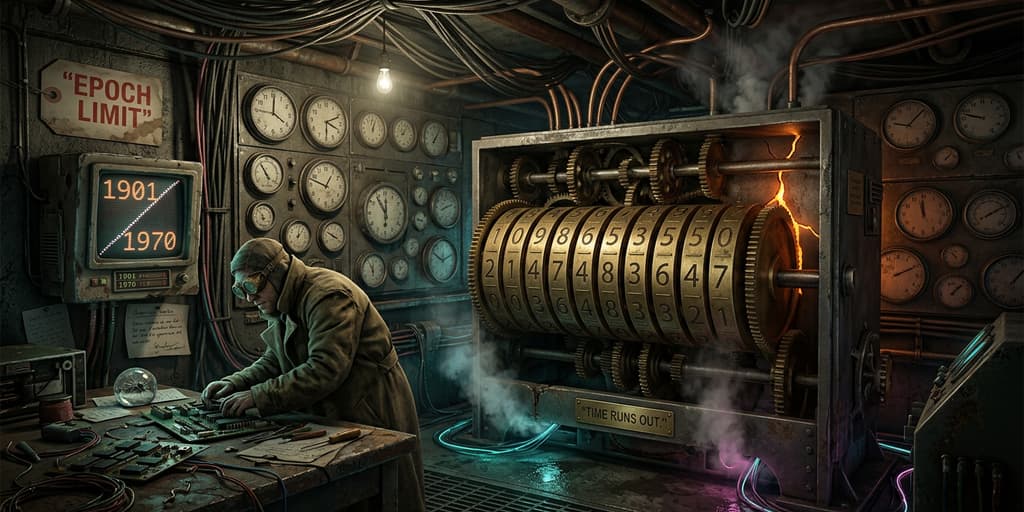
The coming temporal catastrophe
At exactly 03:14:07 UTC on January 19, 2038, a significant portion of the world's computing infrastructure will experience the digital equivalent of a massive stroke. Systems will suddenly believe it's December 13, 1901, or January 1, 1970, or simply refuse to function altogether. Unlike the Y2K bug that had everyone stockpiling canned goods and updating COBOL, this isn't a formatting problem that can be fixed with some clever string manipulation. This is mathematics meets physics, and unfortunately, we can't patch the fundamental laws of binary arithmetic.
The story begins with one of computing's most elegant solutions: Unix time. Back in the early 1970s, when bell-bottoms were fashionable and computers were the size of refrigerators, the developers of Unix needed a simple way to represent time. Their solution was brilliantly straightforward - count the seconds elapsed since midnight on January 1, 1970 UTC. Why 1970? It was a nice round number, recent enough to be relevant, and before Unix existed, computers didn't particularly care about time anyway. This single number could represent any moment in human history (well, post-1970 history) with perfect precision. Want to calculate how long something took? Simple subtraction. Need to schedule something in the future? Just add seconds. No complex date parsing, no timezone confusion, just pure numerical simplicity.
This elegant system worked beautifully for decades. A 32-bit signed integer could store values from -2,147,483,648 to 2,147,483,647, giving us a range from December 1901 to January 2038 - surely more than enough time for those primitive 1970s computers to become obsolete. The developers weren't wrong about computers becoming obsolete; they just didn't anticipate we'd still be running their code five decades later, embedded in everything from heart monitors to traffic lights.
The mathematics of disaster
The problem lies in the cruel precision of binary mathematics. A 32-bit signed integer uses one bit for the sign and 31 bits for the value, giving us exactly 2,147,483,647 seconds of future time from our 1970 epoch. When you do the arithmetic, that lands us at 03:14:07 UTC on January 19, 2038. One second later, the counter tries to increment to 2,147,483,648, but in 32-bit signed integer representation, that number doesn't exist. Instead, it overflows, wrapping around to -2,147,483,648, which Unix systems interpret as December 13, 1901, 20:45:52.
This isn't some theoretical edge case that might happen under specific conditions. This is deterministic mathematics - as certain as 2+2 equals 4. Every 32-bit system counting Unix time will hit this wall at exactly the same moment. When that counter flips, systems won't gracefully degrade or throw helpful error messages. They'll simply start believing they've travelled back in time, with all the chaos that entails.
Consider what happens when a system suddenly thinks it's 1901. SSL certificates, which weren't invented until the 1990s, appear to have expired decades ago. Every HTTPS connection fails. Session tokens that should expire in minutes have been "expired" for over a century. Scheduled tasks set to run daily haven't executed in 137 years, so they all trigger simultaneously. Database queries looking for records "from the last hour" return everything in the database, because from 1901's perspective, everything is in the future. Backup systems might delete all data as "too old to retain." The cascading failures would make the most creative chaos engineer weep with admiration.
What makes this particularly insidious is that we're not waiting until 2038 to see problems. Systems that calculate dates far into the future are already failing. In 2005, banks discovered their 30-year mortgage calculations started breaking when they tried to project beyond 2035. AOL's email servers crashed in 2006 when spam filters attempted to check dates 2^31 seconds in the future. The Network Time Protocol, which keeps computers synchronised, will experience its own wraparound in February 2036, two years before the main event. These aren't warnings - they're early casualties in a slow-motion catastrophe.
The embedded system time bomb
While upgrading your laptop to 64-bit architecture seems straightforward, the real terror lurks in embedded systems - the invisible computers running our civilisation. These devices can't be updated with software patches. They're burned into ROM, sealed inside medical devices, and buried in infrastructure we've forgotten exists.
Consider pacemakers using timestamps for maintenance alerts and internal coordination. When 2038 arrives, that pacemaker might crash or enter a reduced-functionality maintenance mode because it thinks its warranty expired in 1901. The manufacturer might be bankrupt, the engineers retired, and certification for replacements could take years. You can't firmware-update a device keeping someone alive.
Industrial control systems installed decades ago present an even larger nightmare. Power plants and water treatment facilities run on 32-bit processors that can't be upgraded without replacing entire control systems costing millions. That ancient firmware works perfectly until it suddenly thinks it hasn't performed chemical dosing in 137 years and dumps a century's worth of chlorine into the water supply.
Modern cars contain dozens of embedded computers controlling everything from engine timing to airbag deployment. A car manufactured in 2020 will still be on the road in 2040. When 2038 hits, these vehicles might experience anything from entertainment glitches to adaptive cruise control failures. Smart meters, elevator controllers, traffic light synchronisers - they all depend on accurate timekeeping. Many were installed with 25-year lifespans, putting replacement right around 2038, but the companies that made them might no longer exist.
We're already seeing preliminary shockwaves. Financial systems calculating compound interest hit overflow errors. Insurance companies modelling long-term risk discover their software breaks beyond 2038. In 2005, banks found their 30-year mortgage calculations failing when projecting past 2035. The GPS week rollover in April 2019 previewed temporal chaos - when GPS's 10-bit week counter rolled over, older receivers thought it was 1999 again. Aircraft systems reported incorrect dates, financial timing systems lost synchronisation, weather trackers stopped working. The Network Time Protocol will fail in 2036, two years before the main event. When NTP fails, computers can't synchronise clocks - catastrophic for distributed systems relying on precise timing for everything from database transactions to cryptography.
Testing the impossible and finding solutions
Identifying vulnerable systems isn't simple. Modern 64-bit systems can still use 32-bit time representations. Legacy code, database fields from years ago, and APIs designed for compatibility might all use 32-bit timestamps. The vulnerability hides in layers of abstraction. Testing requires more than setting your clock to 2038. Systems have safeguards preventing future dates, cryptographic operations refuse "invalid" timestamps, and licence managers interpret 2038 as bypassing restrictions. The testing process itself creates risks - one major bank's test to 2040 caused their interest calculation system to process 20 years of transactions in seconds, creating a weeks-long cleanup nightmare.
The obvious solution - upgrade to 64-bit time - gives us 292 billion years before overflow. Modern systems have already transitioned: Linux kernel 5.6+, Windows, macOS, and languages like Go, Rust, and Swift all use 64-bit time by default. But transitioning means doubling storage for every timestamp, massive database migrations for billions of records, restructuring binary file formats, and updating network protocols. Every system handling time needs touching.
Alternative proposals create their own problems. Unsigned 32-bit integers extend to 2106 but can't represent pre-1970 dates. Changing the epoch from 1970 to 2000 breaks compatibility with every existing system. These aren't solutions - they're problem multipliers.
The human and economic crisis
The 2038 problem will dwarf Y2K costs. Y2K needed software updates; 2038 requires hardware replacement. You can't patch a 20-year-old industrial controller - you replace it and everything it interfaces with. A typical manufacturing plant has hundreds of embedded systems, each costing thousands to replace, requiring production shutdowns and extensive testing. Multiply across millions of facilities worldwide. The insurance industry is quietly preparing for claims - who bears responsibility when systems fail? The manufacturer who used 32-bit timestamps? The company operating vulnerable systems? If 2038 causes actual failures, litigation could continue for decades.
Perhaps more troubling is institutional knowledge loss. Engineers who designed embedded systems in the 1990s are retiring. Companies have been acquired or dissolved. Documentation sits on obsolete media in forgotten languages. Consider the retired engineers who maintain basement archives of binders documenting systems still controlling critical infrastructure. When these individuals pass away, their knowledge disappears with them. Companies have been acquired multiple times, new owners unaware these products even exist. Nobody wants documentation for "obsolete" systems that work perfectly - until they don't. By the time organisations realise they need this expertise, it might be too late.
Unlike Y2K's clear deadline that focused global attention, the 2038 problem is insidiously gradual. Systems fail sporadically - a mortgage calculation here, a scheduling system there - each addressed in isolation without recognising the pattern. Y2K had narrative urgency - millennium bug, century's end, apocalyptic predictions. The year 2038 is just mathematical overflow. Try explaining to budget committees why millions must replace functioning equipment because of integer overflow. After Y2K "ended the world" (and didn't, thanks to massive remediation), there's scepticism about temporal problems. This success paradox means organisations wait until failures begin - by which time systems fail faster than replacement capacity.
The path forward
The solution isn't technical - we know 64-bit timestamps. It's organisational and economic. We need audits before engineers retire, funding for infrastructure replacement, and legal frameworks for liability. Most importantly, recognition that action is needed now, not 2037.
For developers: use 64-bit time, test beyond 2038, document dependencies. For organisations: audit systems now, especially embedded controls. For everyone: understand that society depends on accurate timekeeping in millions of invisible computers heading toward a mathematical cliff.
The Unix timestamp problem represents technical debt meeting institutional knowledge loss and economic resistance to prevention. We embedded elegant 1970s solutions in critical infrastructure and forgot they existed. Now temporary solutions are permanent dependencies requiring physical replacement, not just code patches.
We have less than 14 years to fix infrastructure that took 50 years to build, running software by retired engineers from defunct companies, documented in forgotten languages. But hey, at least the math behind the failure is elegantly simple - sometimes beauty and catastrophe come in the same package.
Published on:
Updated on:
Reading time:
9 min read
Article counts:
28 paragraphs, 1,677 words
Topics
TL;DR
The Unix timestamp 2038 problem occurs when 32-bit systems storing seconds since January 1, 1970 overflow their maximum value of 2,147,483,647. At 03:14:07 UTC on January 19, 2038, these systems will wrap around to negative values, interpreting the date as December 13, 1901. Unlike Y2K which required software updates, this demands hardware replacement - particularly terrifying for embedded systems in medical devices, industrial controllers, and critical infrastructure that can't be easily patched. Early failures are already occurring in systems calculating future dates, from mortgage software to GPS receivers. While modern 64-bit systems are immune, billions of embedded 32-bit devices installed over decades face a mathematical cliff. The solution isn't technical (we know how to use 64-bit time) but economic and organisational - requiring massive infrastructure replacement before institutional knowledge disappears with retiring engineers.